Uncomfortable Studio
- Apr 30
- 8 min read
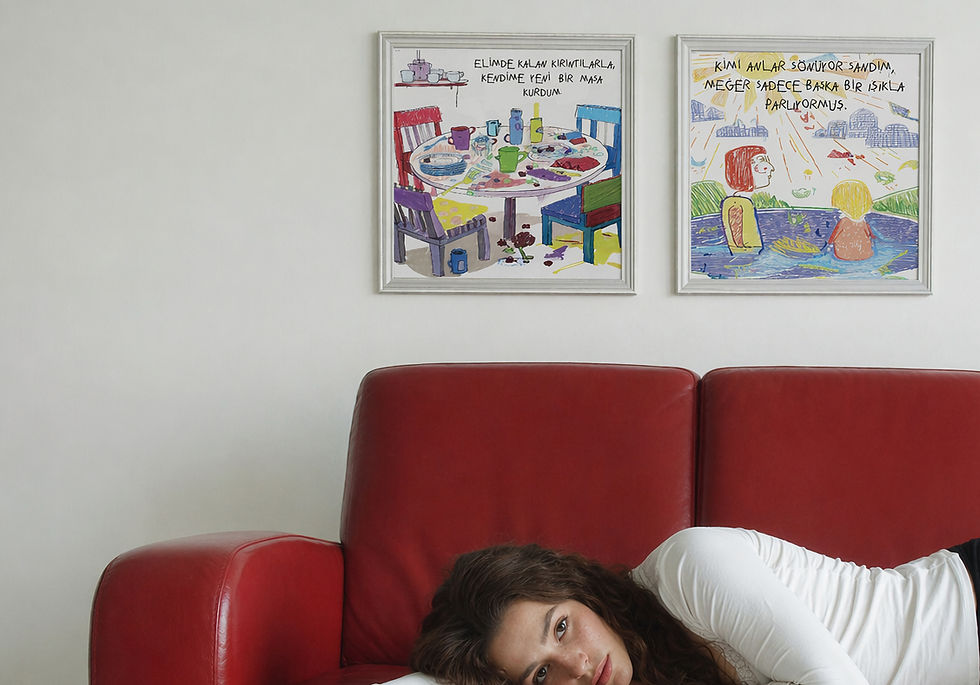
Your brand name is "uncomfortable studio". What does "discomfort" mean to you in design? What emotions do you aim to trigger in the user when designing a product?
"Discomfort" isn't something that's visible in the design itself. At first glance, our work seems the opposite; warmer, softer. But what we call "uncomfortable" is somewhat at the starting point. It's about the place we're in when we formulate those sentences, when we create those works. It's more about emotions that people have inside but don't dwell on, sometimes avoid. There's an ironic connection there. The resulting thing might make you feel comfortable, but the place it's nourished from might not be so comfortable. So instead of directly showing that feeling, we like to convey it in the space we leave in between. Uncomfortable looks a bit like that. When designing something, we also ask ourselves, "What will people feel when they see this?" We genuinely care about that question. But this feeling doesn't always have to come from a good, comfortable, pleasant place. Sometimes it can be something a person avoids thinking about, sometimes a feeling they can't put a name to. Sometimes it just touches something deep inside, but they can't quite explain why. We try to open up that space a little. And one of the most important things for us is that what we create truly belongs to us, but also resonates with someone else. Someone should see it and say, "I haven't seen this before, but it feels familiar somehow." Because there are millions of versions of everything, but they don't all evoke the same feelings. Our concern is actually with that feeling. For a product to go beyond being just something and find a small place in someone's life.
You say, "Sometimes it's good to be uncomfortable." What is the implication of this philosophy in both the production phase (for you) and the consumption phase (for the customer)?
"Sometimes it's good to be uncomfortable" means something similar for us, both on the production side and the other side. In the production phase, it means not choosing the easy way; it means staying with that discomfort until we find something that truly resonates with us. Sometimes we rework something for days... Thinking, dismantling and starting over, not removing something unless you're sure. On the other hand, we want what we've created not just to be appreciated and passed over, but to make the person pause for a moment. Perhaps to touch a place they're hesitant to talk about, or avoid thinking about. That's why sometimes discomfort is a feeling that opens up to a more real and meaningful place for us.
100% handmade production is quite romantic but challenging in today's mass-produced world. What is the biggest challenge and the greatest pleasure you've gained in this "slow production" process?
The biggest challenge is really the slowness :) But this slowness seems somewhat inevitable. Because when you're trying to create something that truly resonates with you, and you take on every stage yourself, the process simply can't speed up. For me, that's actually what slows things down the most: not being able to let go of something until it feels right to me. Deciding on every detail individually, stopping at every stage to revisit and re-examine, erasing and starting over if necessary. Sometimes I get stuck on a very small line or a single word. I spend a long time dwelling on something that seems insignificant from the outside. Because I know that even that tiny detail holds the whole feeling. It can change. That's why the process is longer, but I can't skip that moment either. On the other hand, this is what I value most. In everything I do, I want to look at it through my own eyes, searching for what feels right within me, even in the smallest line or color, rather than relying on external references. When making a decision, I don't want to move forward without finding that feeling. This also prolongs the process, but it's precisely here that determines the character of what emerges. And there's another aspect to it: we are two people, Seray and I. Everything passes through our hands from beginning to end. This inevitably makes the process both intense and slow. Perhaps the most difficult thing in this process is this: you can't hide anywhere. Every decision you make is yours. When you don't like it, when you're unsure, you turn back to yourself. Sometimes I'm very clear, sometimes I completely get lost. Sometimes I say "okay," then I fall into doubt again. That state of being stuck in between, that indecision, that going back to the beginning again and again... that's the most tiring part. But the greatest pleasure begins right there. After so much thinking, so many times going back and forth, something slowly falls into place. To feel. To capture the moment it sinks in. And for that moment to truly come spontaneously. And then there's the moment it leaves you and goes to someone else. To become part of the life of someone you've never met. To feel that you've found a response there. I think that's what keeps me going despite all this slowness. Because at that point, you're not just producing something; everything you experienced in that process remains within it.
You have a wide range of products, from tufted rugs to bags. In the process of turning an idea into a product, do you prioritize the material or the form?
Actually, for us, the starting point is never a material or a form. Sometimes it comes from a conversation, sometimes from a color, sometimes from a fabric we see, and sometimes It's something that's been on our minds for a long time. Because we love to create, we don't stay in one place; but whatever we do, it comes from something that resonates with us, that excites us aesthetically. We put it into practice when we say, "If we were to do this, we would do it like this." I think for us, the product emerges when material, form, and feeling come together.
We see the title "ANATOLIA" in your featured stories. How do you blend traditional motifs or local textures with a modern, "uncomfortable" style?
Traditional motifs and carpet-rug culture have been something that has greatly influenced me since childhood. I was always curious about how they were made, but at the same time, they seemed a little unattainable, untouchable. Even hearing stories about how people used to prepare their own dyes and weave for days really affected me. It was always something I thought, "If I had lived in those times, I would definitely have done this." So, discovering tufting was an important turning point for me; I felt I could approach that world in my own field. My connection with colors, figures, and meanings was already strong. I took things I admired and started thinking, "How would I draw this?" I tried to recreate them with more modern colors and figures, while preserving their stories. I never acted with the concern of sales. After reaching the point where I said, "If I'm going to do this, this is how I should do it," the process continued entirely with searching for which pattern and which color felt right. Reinterpreting the stories carried by the figures in the rugs from today's perspective has been the most exciting part for me. In fact, I always try to build this process from a more subtle, more difficult place. Perhaps that's why a large part of what I do is still not visible; I haven't even shared perhaps 80% of what I produce right now. Because rushing or just producing something isn't enough. Especially on the rug side, I'm moving forward entirely on an axis nourished by our own culture and stories. For the last year and a half, I've been working on a deeper project on this. The "Uncomfortable" line comes exactly from this; choosing the more difficult path, progressing more slowly, and not releasing anything until it feels right to me.
Your profile includes the "Artist" category. Do you see the objects you produce as mere "items" or as "art objects"? Where does the line begin for you?
We definitely don't see them as mere items, but yes, there are products where we are aware that they eventually become items. We always approach this honestly. When making a poster, we don't see it as an item because of its origin, but we are aware that it will eventually become a decorative item, a piece of furniture. The same goes for making a bag or a rug; despite all these feelings, we know that it ultimately becomes an item. But I think the distinction begins right here: that what we do doesn't become something ordinary for people. That it continues to evoke the same feelings. That's why we never see ourselves as just a brand selling items. The "artist" part also reflects this, the origin of the products. None of them start from a simple "let's make this, let's produce that" point. For us, the issue is more about creating meaningful objects.
The note "@uncomfortabledisplay coming:)" is intriguing. Will this new venture be an extension of your main brand, or will it focus on a completely different discipline?
Uncomfortable Display isn't a direct extension of Uncomfortable, but it's not completely detached from it either. It's more of a space where we want to make visible things that we couldn't share there, but that are still ours. Uncomfortable has a lot of ideas, designs, and production languages that haven't materialized into a tangible product but have accumulated on the sidelines. From the beginning, it was a structure that didn't fit into a single discipline; a place where handcrafted and digital, craft and design, idea and application constantly intertwine. As a graphic designer, I enjoy doing many things within this field, so when we founded the brand, an approach emerged from doing everything ourselves. Display is where this approach becomes more visible. Not just for sharing; it's about juxtaposing what we do with other ideas, to see where it will evolve. Perhaps it's where the previously unseen side of Uncomfortable is slowly emerging. Instead of tangible products, we'll be doing much different things there.
What cultural or artistic sources fuel the unique "raw" and "minimal yet assertive" aesthetic in your designs?
I can't attribute this aesthetic to a single cultural or artistic source. For me, the starting point isn't external references, but rather something that comes from within. Of course, there are things I've seen and been influenced by, but they don't determine the direction. It's more like something that's been with you since childhood. Your creativity, your way of life, your way of thinking, how you want to live, and what you want to express… I think these are the biggest sources. Because that's always what's at work when you're creating something. That's why the works I create It spontaneously moves towards something simpler but stronger, less but clearer. I'm starting more from my inner voice, from that place that's been with me since I was very young. What we call "raw" and "minimal but assertive" aesthetics isn't actually a decision; it's the natural result of that inner feeling.
In handmade production, "imperfection" is actually a signature. Do you have a story where a "mistake" you made during the design process later became the most beloved detail of the product?
No :) But this is somewhat related to me and my working method, and it's directly reflected in everything I do. It doesn't matter what I'm doing. Before I bring something to fruition, I already prolong that process considerably on my own. By experimenting, changing, looking again... I don't move forward until I have a clear "yes, this is it" from within. Therefore, there isn't much room left for what we call an error in the final product. Because I reduce that possibility from the very beginning. But it's not just about the decision-making part either. During the process, even the slightest slip, a mishap, or feeling that something I thought would look good isn't quite right is enough. I can't continue there. I intervene, undo if necessary, or start over. So the issue isn't making mistakes; it's that I can't continue anything "without being completely sure." This, to be honest, also makes me approach everything from a slightly more difficult perspective. So, even though I believe mistakes can turn into good things, that's not the case for us. I'm not the type to turn that mistake into a "detail"; I'm usually the type to eliminate it completely.


Comments