Luftmensch
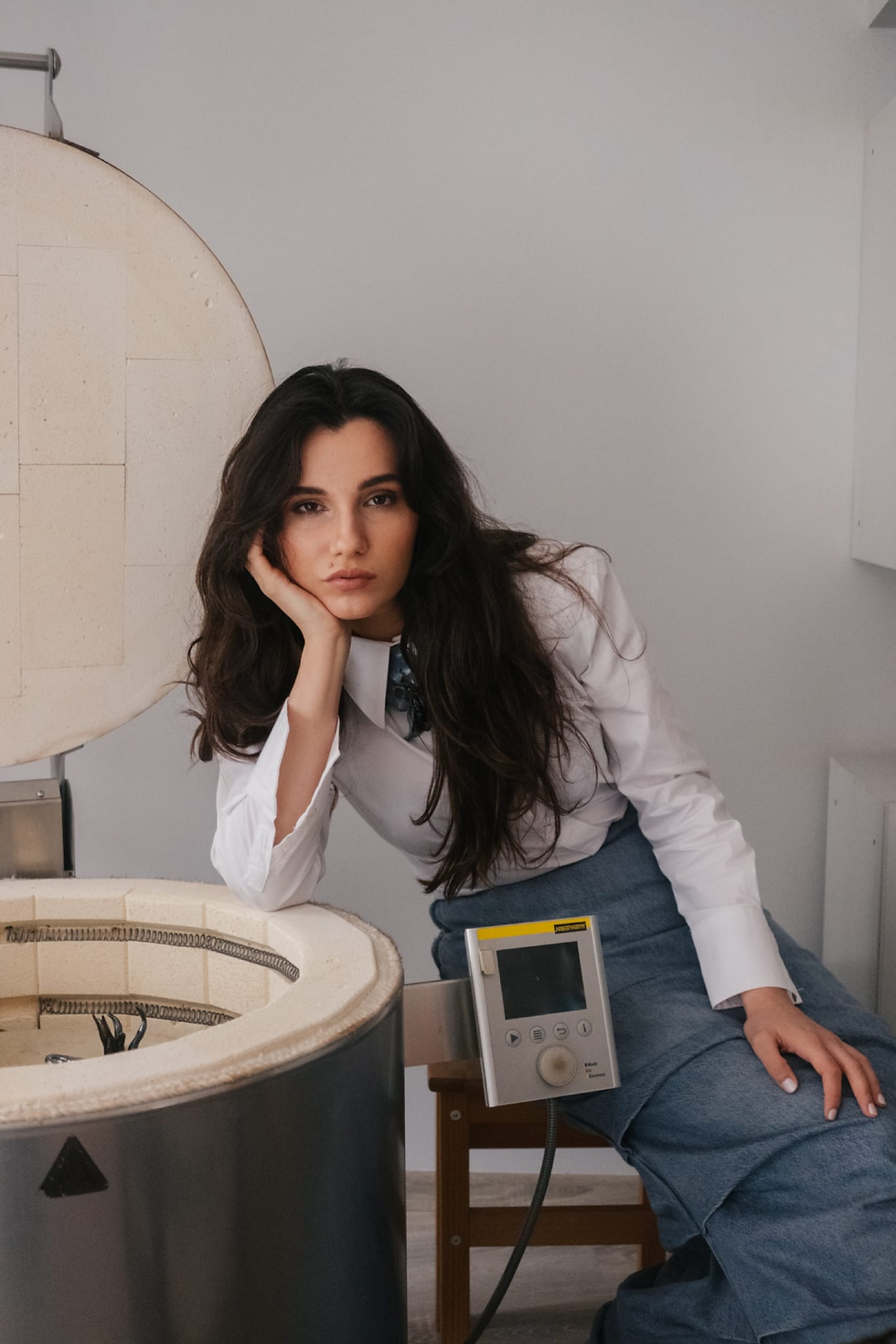
The word “Luftmensch” evokes daydreaming and a belief in the possibility of things that do not yet exist. What did this name mean to you when you chose it?
“Luftmensch” described a side of myself I knew very well. I was constantly constructing dreams, stories, and worlds of my own—and the possibilities within them—in my mind. Yet, for me, daydreaming was never just about remaining in a mental space; what truly interested me was the ability to bring something formless into existence in the real world.
Today, the meaning of the word has expanded even further for me. I view the *Luftmensch* as a space situated between the imaginary and the tangible. My practice is increasingly taking shape around this space: the moment a thought, dream, emotion, or intuition encounters material and finds a physical manifestation—and how that manifestation subsequently acquires new meaning through the experiences of others.
Every collection begins with a story. Where does the process of transforming a memory, dream, or emotion into an object begin for you?
It usually begins with my own inner journey. Sometimes a dream, a memory, a sound, or a small detail lingering in my mind merges with something I am currently experiencing or trying to make sense of. Over time, these elements find their own language through symbols and forms. What fascinates me is how these stories—which originate from a deeply personal place—expand toward a collective memory as they are created. Once people begin to find echoes of their own experiences in those objects, the story no longer belongs solely to me.
In the *Lunapark* collection, this was about the world of play and imagination found in childhood memories; in *Wildflower*, it was about transformation, moving toward the unknown, and discovering new possibilities within oneself. Even though they originate from personal starting points, over time they evolve into worlds where others, too, can embed their own stories.
How does telling a story through form, rather than words, change things for you?
Sometimes, I can convey things through material and form that I cannot express or fully describe with words. Moreover, form doesn’t force me to define the story completely; I can leave part of the meaning open. This openness is invaluable to me because it allows the viewer to construct a new meaning based on their own memory and experience, while also enabling me—when I look at the resulting form—to notice something in my own story that I hadn't seen before. That is why, for me, creating is not just a way of expressing something, but also a way of discovering it.
Are there moments when the material guides you while you work with clay? Or do you determine the form from start to finish?
Today, I view my creative process somewhat like a relationship between two characters. Sometimes I begin with a very clear form in mind; at other times, I change my idea during the process; and sometimes, the material indicates that I should move in a different direction. For me, it is no longer a matter of dominating the clay or surrendering to it completely; rather, it is about respecting its limits while exploring together where those limits might lead.
Glaze, minerals, heat, and the firing process are also part of this relationship. I make the decisions up to a certain point, but after that, I leave the process to the material, the heat, and the chemistry. Consequently, I sometimes encounter results that are vastly different from what I expected—outcomes I could never have designed on my own.
You create wearable sculptures. How do you think the relationship with a sculpture changes when it is worn on the body?
For me, the body is not merely a passive surface for displaying wearable sculptures; it is an active space that engages with the work and transforms its meaning. When a sculpture is worn, it ceases to be a static object; it moves and takes on a new character through the wearer's presence. Likewise, the wearer does not simply display the piece; they choose a form that enters into a dialogue with their own process, effectively becoming an extension of themselves.
Thus, the same piece can be interpreted in entirely different ways depending on the body, movement, or personality involved. At times, it may project a powerful, sculptural presence, while at others, it might naturally shape the wearer's daily life. This organic synergy between the artwork and the individual transforms the act of wearing the sculpture into a process of redefinition.
In your view, what transforms an object from something merely decorative into one that carries meaning?
For me, the meaning of an object begins to take shape during the production process itself. The initial idea or symbol, the way the form emerges, and the process involving the material are all part of the meaning the object conveys. Yet, this meaning need not always be purely symbolic; at times, it transforms into an experience—whether through the way the object is used or through a sense it evokes.
That is why I do not consider an object solely based on its appearance. How it is experienced matters just as much to me as how it is created. Perhaps this is precisely what elevates it beyond the merely decorative: its capacity to embody an idea, a function, or an experience that transcends its aesthetic presence.
The fact that each piece is shaped by hand and bears slight variations is a key aspect of Luftmensch. Why do you choose to preserve these differences?
I view these variations as a record of the production process. Some Luftmensch pieces are unique creations from the very start; since they are entirely hand-shaped and acquire their specific surface characteristics through distinct glazing techniques, exact replication is impossible. While I do repeat certain forms within a series, "repetition" for me does not mean copying. Even as the language of the form remains consistent, the movement of the hand, the state of the clay at that moment, and the effects of the glaze and kiln imbue each piece with a unique character.
I choose to preserve these traces rather than eliminate them. To me, the value of handmade production lies not merely in the technique itself, but in the way it allows each piece to develop its own character. The same concept or form can be reinterpreted, but the actual encounter is never exactly the same. At Luftmensch, this singularity is a natural outcome of the production method rather than an aesthetic of "imperfection" that I am deliberately trying to cultivate.
Is your approach of "slow-making" and small-scale production a conscious choice against today’s culture of rapid, mass production?
Yes, it is a conscious choice. I view it as a way of respecting the time that production requires. Ceramics—which currently lie at the heart of my practice—make this very apparent; The processes of shaping, drying, glazing, and firing each have their own timeframe, and attempting to rush them means interfering with the material's inherent nature. Yet, for me, this approach isn't limited to ceramics alone. When working with other materials, too, allowing space for research, experimentation, and understanding the material's unique character is an integral part of the creative process.
Small-scale production also creates the space for me to preserve this relationship and the uniqueness of each piece. In today’s world, where everything is produced and consumed at such a rapid pace, acknowledging the time required for something to come into being has become increasingly valuable to me. That is why I view "slow-making" not merely as a production model, but as an expression of the care and respect I hold for the material, the process, and the resulting work.
What changed when you transitioned from advertising and brand strategy to your own artistic practice—moving from telling others' stories to creating your own?
Listening to and observing people has always been one of the most enriching aspects of my work in advertising and brand strategy. Interpreting human behavior—whether on a local or global scale—as well as the cultural contexts people inhabit and the connections they form with brands, and uncovering the motivations and shifts behind these relationships, is a crucial part of what I do. I transform insights derived from social listening and analysis into strategies, and subsequently into creative narratives.
Perhaps this has been the most significant shift: I am now translating the world I spent years observing, studying, and interpreting into a physical language through my own artistic practice.
You say, "Sculpture becomes wearable, and objects become stories." For you, at what precise moment does an object transform into a story?
For me, an object’s story begins during the production process; yet, it transforms into a living narrative the moment the meaning I have imbued it with intersects with another person’s life. I shape the form, the material, and the initial intent. Subsequently, as that object becomes part of someone’s body, home, or a specific period of their life, it bears witness to moments unknown to me and becomes a part of that person’s own memory. Thus, an object born initially from my story begins, over time, to carry someone else’s story as well.
To me, the phrase “Sculpture becomes wearable, and objects become stories” captures precisely this idea. A work’s physical form may be complete, but its story need not be. What fascinates me is this living dimension—the object’s capacity to carry new memories as it encounters different lives.


Comments