Üstü Kalsın
Urla has become very popular in terms of gastronomy in recent years. What do you think is the most important reason for this change?
Urla's greatest advantage is that it hasn't completely severed its connection with its land. On one side, there are producers, olive groves, vineyards, artichokes, and fisheries; on the other, there are people who come here seeking a different life. When these two meet, gastronomy naturally grows. But there's also a danger. As a place becomes more popular, it can start losing its soul. If everyone comes to Urla and uses the same dishes, the same decor, and the same phrases, what emerges is not Urla, but a well-packaged industry. I think what's important is not using Urla, but being able to blend into Urla.
When you opened Üstü Kalsın, what was the one thing you said, "This absolutely must be there"?
It had to have a feeling. There are many places that make good food. A nice table, good plates, and expensive glasses can be bought with money. But a place that touches a person's soul cannot be bought with money. I didn't want the people who come here to just fill their stomachs. I wanted them to slow down a little, remember a little, and perhaps turn inward a little. For me, Üstü Kalsın is more than just a business; it's the embodiment of the courage to start anew after a certain age in life. Therefore, authenticity had to come before perfection here.
When creating your menu, did you preserve traditional recipes or did you add your own interpretation?
I respect tradition, but I don't see it as a museum piece. Tradition, after all, has changed over the years in different homes and hands, reaching us today. While preserving the memory of the recipes, we also try to create our own narrative. Changing the name of a dish and adding "modern" doesn't make you innovative. What's important is knowing where that dish came from and being able to retell it on today's table without betraying it. We neither imitate the past nor distort the character of the dish just to appear different.
If you could only recommend three dishes to a first-time guest, which ones would you choose?
I would recommend Nazuktan as an appetizer, lamb sweetbreads as a warm starter, and lamb shoulder as a main course. Because these three represent our cuisine in its simplest form: good ingredients, proper cooking, and a flavor free from unnecessary pretentiousness.
How much of the ingredients used here come from producers in and around Urla? Why is working with local producers important to you?
We strive to work with producers in and around Urla for every possible product. But I don't like using this as a marketing slogan. It's easy to romanticize the dish by saying "local producer"; it's harder to pay the producer for their labor on time and fairly. For me, working with local producers isn't just about the freshness of the product, it's also an economic and political choice. If small producers don't survive, in a few years we'll all be using the same products from the same big suppliers. Then the restaurant names will be different, but the taste of the dishes will be the same. Localism isn't just about how many kilometers the product comes from; it's about who keeps the money and the labor.
Which flavor surprises or surprises your guests the most?
The warm hummus with buttered dried figs, the Sokalı eggplant, and the grilled herb muhammara are the most surprising. They are all familiar flavors, but they come to the table in a slightly different form. Guests are initially curious, then usually finish the plate.
Among so many high-quality restaurants in Urla, what do you think sets you apart?
If I said that what sets us apart is only the food, that would be an understatement. Üstü Kalsın has a certain attitude. We don't see a meyhane (traditional Turkish tavern) as a place where people party loudly, tables are mixed together, and everyone is shouting the same song. For us, a meyhane is a culture where people can hear each other, the table isn't rushed, and there's a measure to both food and drink. Here, we look at the guest, not the customer. But being a guest is also a reciprocal thing. We expect respect for the employee's hard work, the peace of the next table, and the spirit of the place. Perhaps what sets us apart is this: We don't try to be liked by everyone by being like everyone else.
The atmosphere of the place is talked about as much as the food. What did you prioritize most in creating this ambiance?
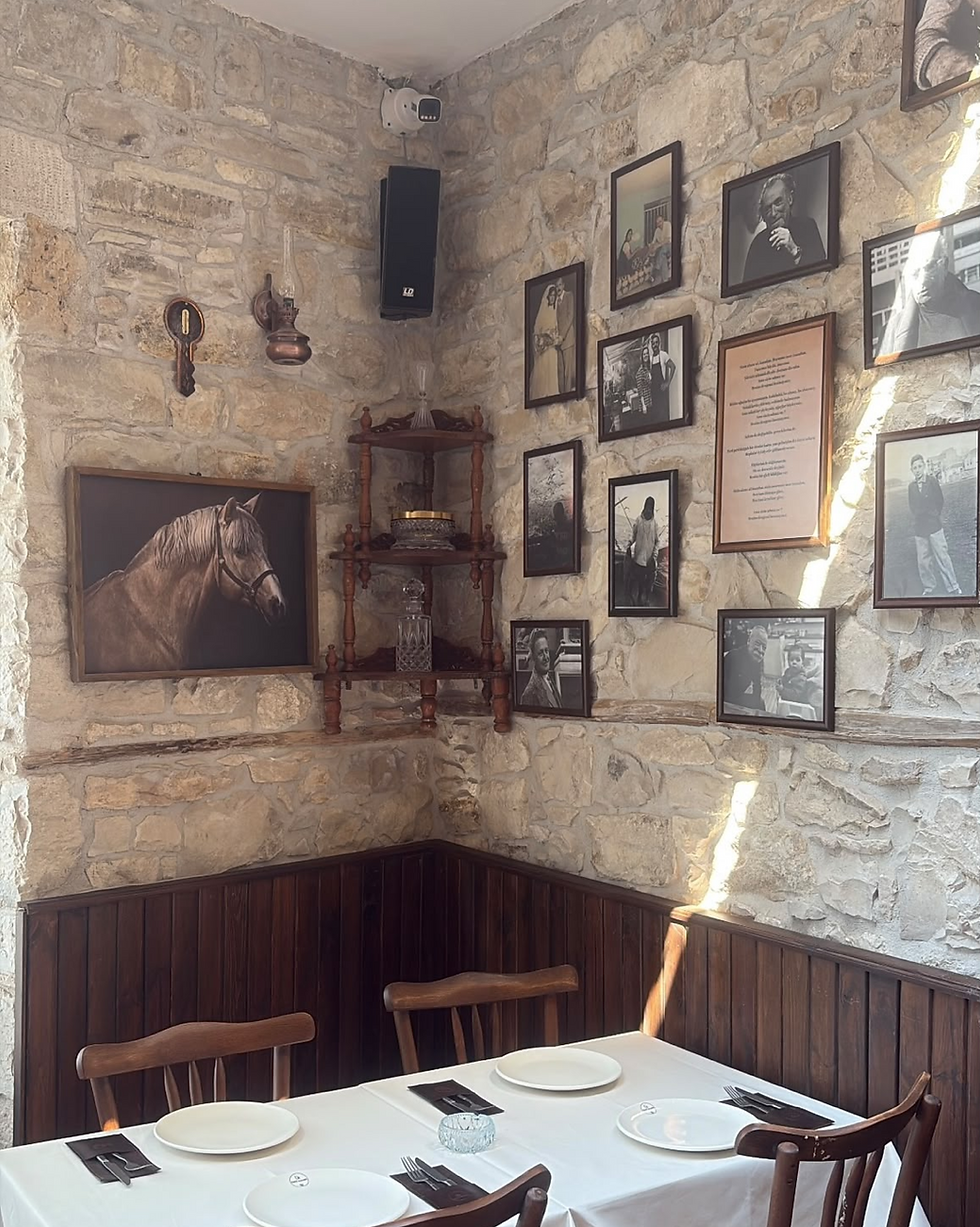
In creating the ambiance, I wanted to bring together the structures, tables, people, idols, and sorrows that I've longed for in my 42 years of life. Most importantly, I tried to recreate the textures of my home, a place I was, in a way, exiled from and had forgotten over time. This is an old Greek house. I didn't want to cover up the building's past and create an artificial "Aegean concept" on top of it. We preserved the age of the walls, the silence of the garden, and the simplicity of the tables. In the decoration, I thought less about "How will it look on Instagram?" and more about "What will a person feel after sitting here for three hours?" The lighting shouldn't expose the person, the music shouldn't overwhelm the conversation. People should leave here remembering not the details, but what they felt.
What customer feedback makes you happiest?
Is there a phrase you particularly enjoy hearing besides, “The food was delicious”? One guest said, “It was like reliving a moment from my childhood that I can’t quite describe. A moment, an age, an evening… But I can’t say, ‘This moment, this age, this evening.’” This sentence deeply affected me. Because that’s exactly what we want to convey: a feeling you can’t put a name to, but that touches you deeply.
Do you think tavern culture has changed over the years? Which aspect of it are you trying to keep alive?
Of course it has changed. At one time, tavern culture was a place for conversation, literature, politics, friendship, and dissent. Today, it’s sometimes reduced to just loud noises, unlimited consumption, and social media imagery. I don’t glorify the past; not everything was great in the past either. But I value the democratic side of the tavern. I try to keep alive the idea that titles are erased at the same table, that people listen to each other, and that the table is a space for sharing, not a spectacle. Our political side isn’t about writing slogans on walls. Respecting the labor of the worker, protecting small producers, creating an environment where women feel comfortable, not discriminating against people based on their wealth, and not mistaking noise for entertainment. I think a real tavern is a bit like a homeland: everyone can speak, but no one should drown out another's voice.
Do you have any new projects or surprises planned for Üstü Kalsın in the coming period?
We want to take Üstü Kalsın to the place we believe it deserves in terms of gastronomy. We intend to understand the table culture that the Greeks left to this region correctly and keep it alive with the power of our own cuisine. For us, the culinary ethics are very clear: quality products, freshness, seasonality, and sustainability. In the coming period, without compromising on these, we want to show the power and ethics of our cuisine to more people.
If someone leaving here could only remember one thing, what would you want it to be?
I would want them to think, "Someone here really believed in what they did." Because today everything can be quickly copied: the menu, the decoration, the music, the plates, even the appearance of sincerity. But the risks a person takes for what they believe in, the sleepless nights they endure, the burden they carry—these things cannot be replicated. I want the person who leaves "Let It Be" to be left with not just a meal, but a feeling. A little incomplete, a little beautiful, a little sad… Just like life.


Comments